
Cylindrical Roller Bearings: NU, NJ, NUP & NN Types Explained
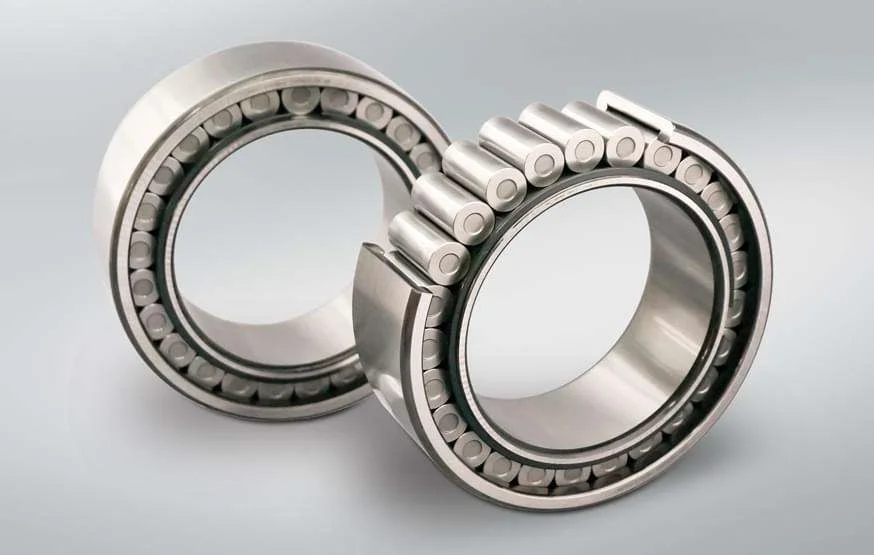
Cylindrical roller bearings look simple — a row of straight rollers between two rings — but the letters in front of the number decide where the bearing can sit on a shaft and what it does there. NU, NJ, NUP, N and NF are five single-row executions of the same bearing, and NN is the double-row version. This guide explains how the rib arrangement on the rings creates floating and locating positions, how to choose the cage and clearance, and how to read a designation such as NU310 before you order.
Why this family: line contact and a separable design
Rollers meet the raceways along a line rather than a point, so a cylindrical roller bearing carries heavy radial load in a compact section and runs with low friction. The rings are separable — inner ring, outer ring and the roller-and-cage assembly can be mounted separately — which makes fitting and inspection fast and lets one ring be an interference fit without pressing the whole bearing. That combination is why this family is the standard choice for electric motors, gearboxes, pumps, machine tools and rail gearboxes. NKEN manufactures the range at its Shandong factory; the full NU table with dimensions is on the cylindrical roller bearings page, and NJ, NUP, N and NF executions share the same boundary dimensions as the NU bearing of the same number.
The five single-row types: it is all about the ribs
The type letters describe which ring carries ribs (flanges) that guide the rollers and take axial contact. The radial internals are the same; the axial behaviour is not.
- NU — two ribs on the outer ring, none on the inner ring. The shaft can move axially through the bearing in both directions: a true floating bearing.
- NJ — two ribs on the outer ring and one rib on the inner ring. It locates the shaft in one direction and carries axial load that way, while still floating the other way.
- NUP — an NJ bearing plus a loose rib ring on the inner ring, so the shaft is located in both directions. It separates for mounting like an NJ and then closes up into a fixing bearing.
- N — the mirror image of NU: two ribs on the inner ring, none on the outer ring. Floating in both directions, with the outer ring free in the housing.
- NF — the mirror image of NJ: two ribs on the inner ring and one on the outer ring, locating in one direction.
None of these is a thrust bearing: axial location here means guiding the shaft position and taking the modest axial forces of normal service. Where a position must be located firmly in both directions with higher axial load, the usual answer is a locating bearing of another family at that end — or a NUP, within its axial duty.
Floating end or locating end: choosing the pair
Almost every shaft is carried the same way: one locating position fixes the shaft axially, and every other position floats so that thermal expansion and machining tolerances have somewhere to go. If both ends are locked, the bearings load each other as the shaft warms up.
- Floating end: specify NU or N. The rollers travel axially between the ribs, absorbing shaft growth invisibly — this is the classic arrangement at the non-drive end of an electric motor or opposite the locating bearing of a gearbox shaft.
- Locating end: specify NJ where axial location is needed in one direction only (often paired with a second NJ facing it, or with the axial duty taken on one side), and NUP where one bearing alone must locate the shaft in both directions — a common choice for smaller gearbox and pump shafts.
- Two cylindrical bearings, no other locating bearing? Then one of them must be the NUP (or an NJ arrangement), and the rest NU — never two fixing executions fighting each other.
NN: the double-row version
NN bearings carry two rows of rollers in one wide bearing. Two rows roughly double the contact length, so NN is chosen where the position needs maximum radial capacity and stiffness in a fixed width — above all precision machine-tool and heavy spindle positions, where NKEN supplies the family to P6 and P5 precision on request (standard production is P0). The trade-off is the mirror of the single-row types: NN is a specialist position bearing, while the NU/NJ range is the flexible system for building complete shaft arrangements. If your drawing shows an NN, order it as drawn — do not substitute two single-row bearings without an engineering check of width, preload and stiffness.
Cage choice: steel, brass or polyamide
The cage keeps the rollers spaced and guided; it does not carry load, but the wrong cage still ends bearings early. NKEN supplies this family with three cage executions, named in the designation by suffix:
- Pressed steel (no suffix) — the standard cage for general motor, gearbox and pump duty: robust, economical, and the default when the designation you buy today carries no cage suffix.
- Machined brass (suffix M) — a solid cage machined from brass, chosen for larger sizes, shock and vibration, and heavily loaded positions; for example, NU310 from our table is supplied with pressed-steel or machined-brass cage — if your service is severe, ask for the M execution explicitly.
- Polyamide (suffix TN) — a moulded polymer cage: light, quiet and smooth-running, well suited to standard electric-motor duty where running noise matters.
Rule of practice: replace like with like. If the bearing you remove has a brass cage, the duty probably justified it — quote the same execution, and tell us the application if you want the cage choice checked.
Clearance: CN, C3 or C4
Radial internal clearance is the small freedom the rollers have before the fits are applied — and interference fits consume it. NKEN production is CN (normal) clearance as standard, with C3 and C4 available on request. Stay with CN for standard fits and moderate temperature differences. Step up to C3 when both rings are tight fits, when the shaft runs notably hotter than the housing (the inner ring grows and squeezes the clearance), or where your machine builder's specification simply calls for it — many motor specifications do. C4 is the further step for the hottest, tightest positions. Clearance is a suffix on the designation, so the bearing you order must carry it in writing: “NU310” and “NU310 C3” are different bearings on the shelf.
How to read the designation
A cylindrical roller designation is a short code: type letters + dimension series + bore code, followed by suffixes. Take NU310. NU is the type (floating, ribs on the outer ring). The 3 is the dimension series — in this family the series digit and its width partner set the section: the 10 series is the light section, 2 and 3 are the standard sections, 22 and 23 are their wider versions, and 4 is the heavy section, all visible side by side in our model table. The bore code 10 multiplies by five: a 50 mm bore — so NU310 is 50 × 110 × 27 mm. Add suffixes for execution: E for the reinforced internal design listed throughout our table, M for a machined-brass cage, C3 for increased clearance. Change the type letters to NJ310 or NUP310 and the boundary dimensions stay the same — only the axial behaviour changes, which is exactly why getting the letters right matters more than getting the number right.
Typical applications
- Electric motors — NU at the floating end, often with C3 clearance; for variable-frequency drives, the same positions are available with ceramic insulation coating in the standard VL / J20 insulation classes — see the electrically insulated bearings page.
- Gearboxes — NU/NJ combinations carrying high radial gear forces, with NUP locating input shafts on smaller boxes.
- Pumps — compact high-capacity positions on pump shafts, brass cage where the service is severe.
- Machine tools — NN double-row bearings for stiff, precise spindle positions.
Selection, step by step
- 1. Fix the position's job: floating (NU/N) or locating (NJ one way, NUP both ways) — one locating position per shaft.
- 2. Take the dimensions: bore, outside diameter and width from the old bearing or the drawing, and find the number in the 294-model table.
- 3. Choose the cage: steel as standard, brass (M) for shock, large sizes and severe service, polyamide for quiet motor duty.
- 4. Set the clearance: CN standard; C3 for tight fits and hot shafts; write the suffix into the order.
- 5. Send the full designation — type letters, number and every suffix — with quantity and destination, and we confirm execution, price and stock. If the old bearing's letters are worn away, send clear photos of both faces and the measurements; we identify the type from the rib arrangement.
Next step: browse the cylindrical roller bearings page for the full 294-model NU table with dimensions, or send your designation through the inquiry form below and we will confirm the type, cage and clearance with your quotation.